djfa.aiPart II: Examples

AI Productivity Guide

The Orchestrator
vs. The Wheel Spinner

By Jeff Nash

January 14, 2026

Scroll
Introduction

The Great Searcher/Orchestrator Split of 2026

It's 2026, and there's a burgeoning split between two types of people trying to use AI to increase their productivity. Let me be clear: I am talking about those who actually want to use it to increase productivity. Not those who hate or refuse to use it altogether. Of the eager and willing, there are two types of people using the same LLMs, trying to perform the same tasks with the same deadlines. One of them looks like they've been in a fistfight with the ChatGPT interface for about three hours. They're rage editing, fact-checking, fixing hallucinated code. In fact, they're exhausted.

The other person looks suspiciously fine. They're shipping, they're calm, and most importantly, they're getting way more done. And the difference, I'm sorry to say, is not secret prompt hacks. It's not magic phrasing or being born an "AI wizard." It's a mental model.

Most people in 2026 are confusing one thing, power, with another thing, autonomy, as it relates to AI. Perhaps it's because AI powers some of the most amazing autonomous vehicles of our time, but AI powering self-driving cars doesn't mean that every AI task can automatically drive itself. They think that because a machine is strong, it must also be self-driving and able to navigate itself. And that mistake is why these people keep spinning their wheels.

In this article, I want to tell you how to be an orchestrator: to use AI to get each specific task done, rather than a wheel spinner.
Chapter 01

The Bicycle for the Mind (Updated)

There's a famous Steve Jobs idea; he called computers a "bicycle for the mind." In an interview, he referenced a study about the efficiency of locomotion across different species: how much energy does it take for different animals to travel a given distance? The condor was at the very top of the list; it was insanely efficient. Humans were not great. But if you gave that human a bicycle, a completely man-made invention, suddenly we were ridiculously efficient. It wasn't even close. The machine, through our own ingenuity, amplified our effort.

"The machine, through our own ingenuity, amplified our effort."

For decades, that's what computers were. A mechanical advantage, better gears for your brain. You had spell check, copy-paste. If you were a programmer, you had an IDE. If you liked to text, you had autocomplete. But the physics still stayed linear.

Computers very quickly became integrated into society and the workforce as just another tool, this time for your brain. Just like how the drill or the automobile made screwing in a screw or transportation more efficient, computers made tasks like writing and math much, much easier. And though some jobs changed, productivity quickly increased. Accountants didn't go out of business because they no longer had to bookkeep by hand; quite the contrary, they used the same expertise they always had, and spreadsheets made them much more precise, much more efficient, and much quicker.

But the fact remained: even with the best word processor in the entire world, if you stopped typing, the essay didn't get written. Even with the best IDE in the entire world, if you stopped coding, your feature didn't ship. You had better gears, but you were still the force that pedaled to move the bicycle that was your mind.

Traditional Computer

Better gears for your brain. Spell check, copy-paste, IDEs, autocomplete. You had to pedal, but the physics stayed linear.

You stop typing → Essay stops

AI-Powered

The electric motor. Push a button, the bike moves. Pedaling has been decoupled from output itself.

You steer → AI pedals

AI changes the physics entirely. AI is the electric motor. You push a button, and the bike moves. Pedaling, the raw labor, has been decoupled from output itself and is now powered by LLMs rather than your brain. But all this power with no control creates the most common failure mode of 2026, and I call it "The Oscillation Trap."

Chapter 02

The Oscillation Trap

Here's what it looks like. Imagine two groups.

Group A are the Wheel Spinners. They're bouncing between two extremes. They see some crazy YouTube video or example about AI doing something insane, and they go into full "this is magic" mode. They'll type in: "Build me an app," "Do financial research on Tesla," "Write the perfect plan," and then mentally take their hands off that bicycle's handlebars. And maybe initially it seems to work, until it very, very quickly doesn't.

The luster wears off and reality soon hits. The AI begins to drift from what you thought you told it. It misses a constraint that you thought was maybe implied. It begins to hallucinate entirely, confidently inventing details that we would accuse any human of pulling out of you know where. After enough of this, when you can no longer rationalize these glaring mistakes as one-off abberations, you throw up your hands. At this point, you've maybe spent half the time that you allotted on your task trying to get AI to do it. Instead of using that time to be productive, you realize you've essentially been playing with a silly toy. So you panic and swing to the other extreme. You delete all the AI's output and start rewriting everything line by line, micromanaging the AI as if it were the world's worst intern, and sweating. You're getting the worst of both worlds. You're eating the risk of delegating to a machine while still having to put in the labor of a human.

Group B are the Orchestrators. They recognize that, while we now have an electric bicycle, you should still never, ever, ever let go of the handlebars. They don't need to pedal anymore, but they steer constantly. A task like transforming a list of UK-style birthdays (DD/MM/YY) into US-style birthdays (MM/DD/YY), sorting by month, and calculating the age each will be turning on their next birthday is now beneath them, but they need to know how to ask. The rest of this article breaks down exactly what they understand and how they leverage AI in 2026 and beyond, so you too can stop oscillating and start compounding.

The Wheel Spinner

Bouncing between extremes

Types "Build me an app" and takes hands off handlebars

AI drifts, hallucinates, misses constraints

Panics and micromanages like worst intern ever

Gets worst of both: risk of machine + labor of human

Magic Mode → Crash → Panic Mode → Repeat

The Orchestrator

Steering constantly

Recognizes AI is electric, but never lets go of handlebars

Doesn't pedal, but steers constantly

Designs processes instead of asking for answers

Compounds instead of oscillating

Define → Execute → Refine → Ship

Chapter 03

The Google Trap

Why does your brain start to treat AI like Google? Well, it comes down, as always, to UX. Here's the first problem: the initial interface we all learned to love for AI, the ChatGPT-style chat, looks so much like a Google search box. It's the direct path from AI to your brain as you first knew it. So 20 years of conditioning kicks in: Text box equals query equals answer. And that's why so many people never unlock AI beyond "search and summarize" or "generate me this."

Think back to 2004: Janet Jackson, the Super Bowl, the whole internet melting down. There were two kinds of searches. The noobs would type questions like a human into Google: "What happened at the Super Bowl with Janet Jackson and Justin Timberlake and why are people upset?" Accordingly, they got garbage results: random music forums, random noise, random 404s. The power users knew what to do. They typed in: "Janet Jackson Super Bowl video filetype:mpg," and they got exactly what they were looking for.

Back then, being smart meant learning how to speak "Keyword-ese" in order to talk to what was essentially a dumb machine. In 2026, we have the opposite problem. We're talking to a powerful machine like it's a dumb one. We'll ask for vague outputs like "research on X", "a plan to do Y", which you wouldn't dream of giving as complete instructions to your real human coworkers. You understand that they don't have access into the inner machinations of your mind, so you go into more detail. And somehow, for all the inappropriate anthropomorphization we apply onto AI, we still expect LLMs to figure out what we meant?

Here's the new split. If you want to use AI to get things done, you do not ask for nouns. You don't ask for "the answer", "the summary", "the best strategy", "the code". You're just the searcher. The Orchestrator asks for verbs and creates pipelines. Compare these three documents, extract contradictions, and format them as a table. Then draft a recommendation memo.

Asking for Nouns
Write the code

Vague question → Vague expectation → Vague sludge

Asking for Verbs
Compare these 3 docs, extract contradictions, format as table

Process → Structured output → Refinable result

And here's the uncomfortable truth, I'm sorry to say: As much as it would be nice, AI does not replace your brain. It scales your brain. So if you don't know what "good" looks like, you're going to ask vague questions with vague expectations and get vague sludge in response. The model, if given the right input, can execute a process precisely and beautifully, at least by the end of 2025. But you still have to describe that process, often in excruciating detail. That is the 'work' that comes with being an Orchestrator.

Chapter 04

The Ron Burgundy Effect

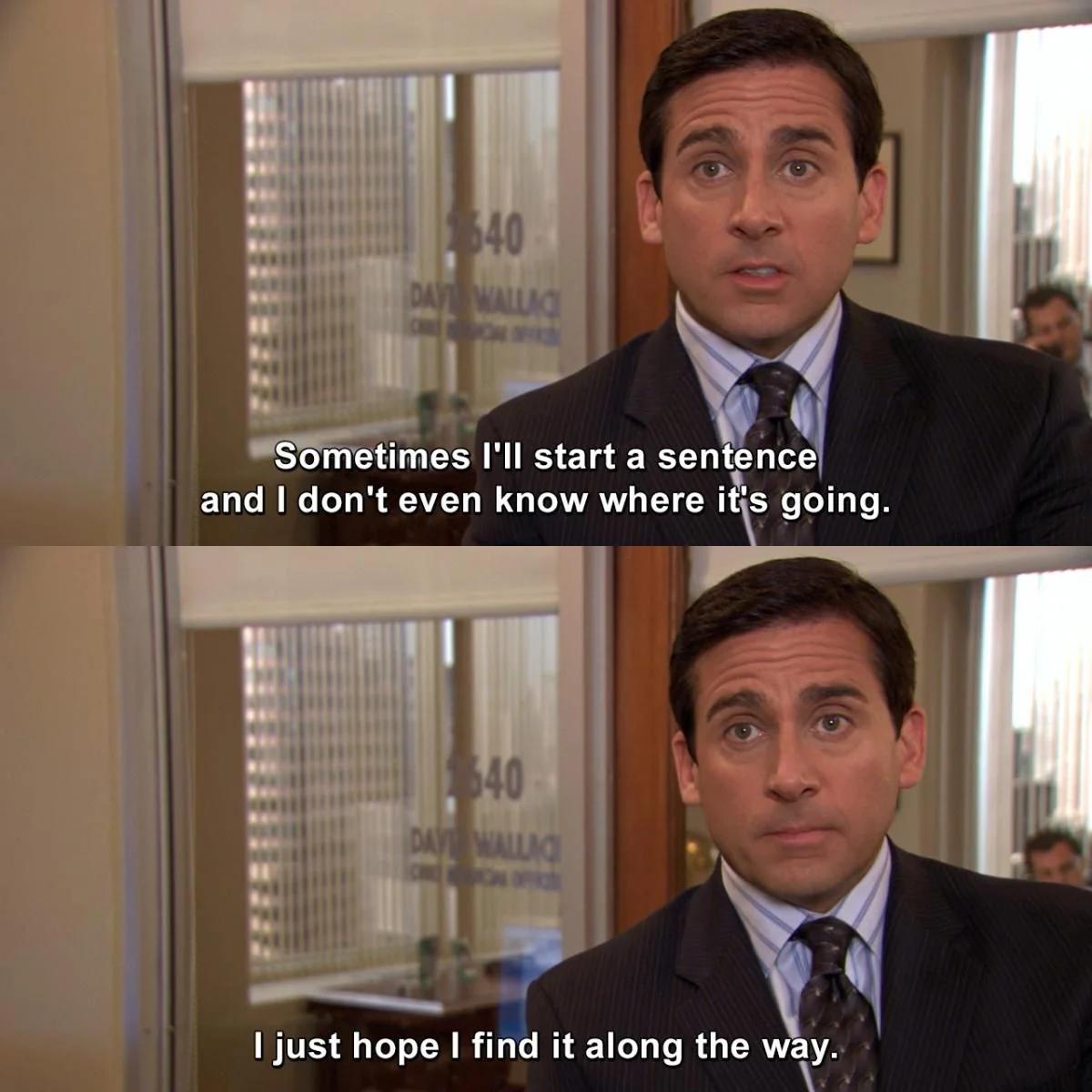
Let's think of Ron Burgundy like the AI inference loop. This is the part that many do not get about AI. Most people think that AI thinks like we do; they treat their interactions with LLMs as if models have a vague awareness of where their ideas are going before they start "talking". Humans (except for Michael Scott) have a pre-verbal buffer. Before you start a sentence, you at least have the shape of the thought in your head.

Michael Scott from The Office
"Sometimes I'll start a sentence and I don't even know where it's going. I just hope I find it along the way."

— Michael Scott, The Office

LLMs work exactly like this. They discover the sentence one token at a time.

LLMs don't work like that. They work like Ron Burgundy. He gets up every day, puts on his unmentionable cologne that works 60% of the time, all the time, and reads the teleprompter. He doesn't interpret what's being said, he doesn't sanity check before it escapes his lips, or look a few paragraphs, sentences, or even words ahead. So when the teleprompter says "Go fuck yourself San Diego," Ron Burgundy delivers it with full confidence because he, too, discovers the sentence one word at a time.

That's the inference loop. At any point during the LLM inference loop, at Token N, the model is merely choosing the Token N+1 that's most likely. It's not thinking about N+2. It doesn't have a concept that there is an N+2. It's just thinking about (read: selecting from a probability distribution) the next token. There is not a completed paragraph sitting in its head, or a completed thought. The output is the thought. If it hasn't actually generated that token, it hasn't arrived there yet.

LLM Inference Loop
READY

The Key Insight

At each step, the AI only sees what it has already generated. It has no awareness of how the sentence will end. The "future" tokens don't exist yet, not even as a plan.

Generated Output

The|
Current token
Past tokens
Future (unknown)

Predicting Next Token After "The"

weather23%
SELECTED
best18%
most15%
sky12%

The model samples from this probability distribution. It doesn't "know" what comes after. It's just picking the most likely next word.

Token 0Token 1

The model only ever thinks one token ahead. Token N+2 is completely unknown until Token N+1 is generated.

So when someone says in a prompt, "Be perfect, don't hallucinate, don't drift, don't miss details," you're basically asking Ron Burgundy himself to be a Pulitzer Prize-winning journalist with a concept, a roadmap, fact-checking, and a memory. He's just not that. That's not what he's built to do. He's a talented and very handsome mechanism that reads what's in front of him.

This is why "Chain of Thought" worked. If you remember the very beginning of 2025/end of 2024, we had that 'DeepSeek moment' where suddenly, with the same amount of training, models were becoming much smarter due to a trick that seemed almost too good to be true. We forced the model to generate intermediate tokens before it came to an answer in a special 'thinking' block. This block, with the implicit understanding that it wasn't considered final output, allowed models to build a bridge step-by-step instead of leaping over a canyon directly to the 'real' output.

Orchestrators understand this operationally. They are able to leverage this same 'bridge-building' pattern to force implicit sanity/reality checks along the way. So they will not ask for perfection or a complete end result instantly. They will force structure, creating intermediate prompts where we ask the model to outline first, list assumptions, define constraints, draft three options, have the AI critique itself, and then write the final. All in separate messages or even converstaions. They don't ask for the model to be silent and perfect and "poof" produce something beautiful. They ask it to think out loud in a controlled way, perform a sanity check on the output, and use that output as part of the input for the next step. That is thinking out loud in a controlled way. That is steering.

Chapter 05

The Evolution of the AI Stack (2023-2026)

To understand why this leverage of the bicycle looks so different now, you need the last three years in perspective.

Operating Systems2026

Orchestration

But really what happened is you handed a motor to someone and assumed it came with brakes. Over 2025, agents got less like a product demo and more like infrastructure. We learned patterns. We learned you don't want one "God Model" doing anything. We learned roles, specialists, checkers, supervisors. And what we now know as "Agent Orchestration" started to come to fruition.

By mid 2025, we were in full swing. People were talking about software engineers being obsolete, entire teams being managed by AI, and we even started to see AI code reviews on GitHub. Linus Torvalds himself just pushed an AI change to GitHub, which is huge.

So by late 2025, the pattern stabilized. We started building what suspiciously looks or sounds like operating systems: supervisors, retries, timeouts, budgets, guardrails, context compaction, schemas for tools, evaluation loops, routing. This was the preemptive multitasking moment. Old systems were cooperative; if one agent hung, the whole flow froze and failed. Now, the Supervisor (Agent) would simply kill the stuck process and respawn the agent again, maybe with better instructions. It had the implicit understanding that reality doesn't come from perfect intelligence; it comes from Managed Intelligence.

And here's the punchline: In early 2026, we are no longer debating "Is AI smart?" We're debating "How do we harness this intelligence? How do we manage it?" The raw horsepower is now spoken for. The electric motor is plenty fast. So the bottleneck isn't intelligence or, when grounded correctly, accuracy; it's orchestration. It's steering.

Chapter 06

The Steering Playbook (2026)

Looking forward into 2026, here is where it's going. You'll have swarm management. Maybe a high-reasoning "Manager Agent" making the plan, ideally with a high context window like Gemini 3 and a strong ability to reason. Then you would have fast "Worker Models" executing tasks, ideally in parallel if you can afford it. Critic models would reject bad outputs and demand fixes. The supervisor would tie it all together, enforcing time, cost, and ultimate correctness toward the ultimate goal.

Your job becomes less about prompting and more about staffing. You're designing a factory line, one that you monitor. And the people who are going to win in 2026 are going to learn the patterns.

So, how do you actually learn to steer? Let's call it "Mechanical Sympathy." What do these orchestrator people understand that everyone else doesn't? You don't need to know CUDA kernels, but you need runtime awareness. Just like a great engineer doesn't need to know memory registers anymore but understands latency and debugging, you need the Steering Playbook.

The "Genie users" (Wheel Spinners) flood the context window with 50 PDFs and weeks of chat history, then are shocked when the model misses details. Orchestrators treat context like money. They ask: "What does the model best need to succeed right now, and what might be extra?" They prune, chunk, and summarize. They keep signal high.

You don't want to have a discussion about five different parts in one thread. Orchestrators do garbage collection. They summarize what was decided and start a whole new thread.

Know when to use GenAI versus tool calling. Determinism over confidence. Orchestrators don't type in "What is the square root of 492,034?" or "What is the price of BTC?" if they don't know for sure the model has access to a tool to manually compute that value or look up that price. They instruct the LLM to use a browser tool or curl an API, look up the price of Bitcoin on a reputable site or API, cite the source, and include the timestamp. They route truth to deterministic systems that we trust.

Stop treating one output as destiny. Asking an LLM something one time is one roll of the dice. Orchestrators sample. They ask AI to give three approaches, critique all three, and then have another AI pick the safest. Then they refine.

Every abstraction leaks. Orchestrators preempt leaks. You don't have to do wizarding magic; you simply provide docs, provide examples, define acceptance tests, and force structure in the output. That is simply systems engineering for the AI age.

Stop inventing and start using patterns. Map/Reduce, Evaluator/Optimizer, Router, Planner/Executor. Supervisors with budgets and retries.

Map/Reduce

InputWorker 1Worker 2Worker 3MAPReduceCOMBINEOutput

Split work across parallel workers, then combine results.

Evaluator/Optimizer

GeneratorDraftEvaluatorFeedback LoopFinal

Generate, evaluate, and iterate until quality gates pass.

Router

QueryRouterCode AgentSearch AgentMath Agent

Route queries to specialized agents based on task type.

Planner/Executor

GoalPlanner(high reasoning)PlanExecutor LoopStep 1Step 2...Replan if stuckDone

High-reasoning planner creates steps; fast executor runs them.

AI is not a "make it good" button. You can only delegate what you specify. You have to define "good." If you walk onto a construction site and yell "Build a house," you get a disaster. You need to be the foreman. You provide the skeleton; AI provides the muscle. If you show up with no skeleton expecting the AI to be architect and builder, you get mush.

Conclusion

Stop Pedaling. Start Steering.

Let's bring it back to the bicycle. The biggest misunderstanding of 2026 is confusing power with autonomy. The Wheel Spinners go hands-off and crash. Then they spend hours pushing the bike uphill manually. Manual labor is the penalty for not steering.

Orchestrators understand they need to steer. The motor does the pedaling, that's why you get paid. You get to relax a little bit because the heavy lifting is gone. But you stay engaged. You do micro-corrections, route planning, and break when it drifts. You structure the workflow so it can't fail silently. You always want observability.

Once you internalize all of that, you're going to stop Googling with AI and start building with it.

Stop asking AI for answers.

Start designing processes.

Stop Pedaling
Start Steering

An interactive essay on AI productivity in 2026

© 2026 Jeff Nash